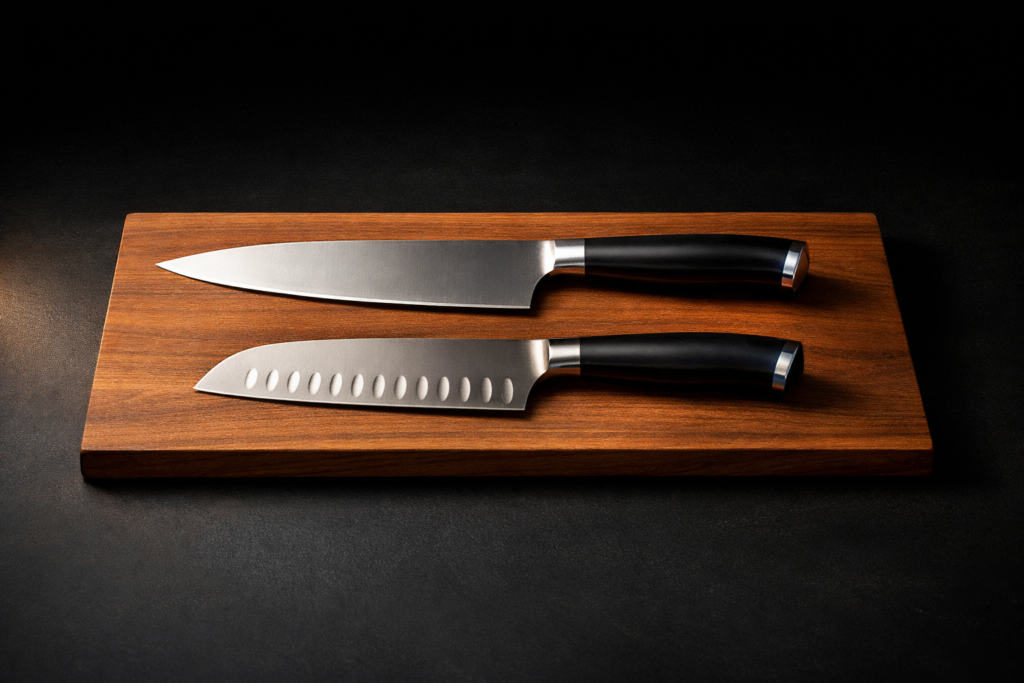
If you are weighing chef knife vs santoku, the short answer is this: choose a chef’s knife if you want one do-everything blade with a curved edge and a familiar rocking motion; choose a santoku if you prefer a shorter, flatter, more nimble knife for slicing, dicing, and straight up-and-down chopping. Both are excellent general-purpose kitchen knives, but they feel different in use.
The better knife is not the one with the louder reputation. It is the one that suits your grip, your cutting style, your board space, and the ingredients you prep most often. Here is how to tell them apart and decide with confidence.
Chef knife vs santoku: the main difference
A chef’s knife usually has a longer blade with a pronounced curve toward the tip. That curve helps the knife rock smoothly on the board, which is why many cooks like it for mincing herbs, chopping onions, and handling a wide range of tasks.
A santoku is usually a little shorter and has a flatter edge profile. It is designed for clean, efficient slicing and chopping with less rocking. Many santoku knives also have a broad blade and a sheepsfoot-style tip, where the spine slopes down to meet the edge.
In simple terms:
- Chef’s knife: more curve, more rocking, often more tip work, slightly more reach.
- Santoku: flatter edge, straighter chopping stroke, often feels compact and controlled.
Neither shape is automatically better. The difference is mostly about movement, comfort, and the kind of prep you do most.
What a chef’s knife is best at
A chef’s knife is the classic all-purpose kitchen blade. Common lengths are around 20 cm (8 in), though shorter and longer versions exist. If you only want one main knife, this is often the safest choice because it adapts well to many techniques.
Strengths of a chef’s knife
- Versatility: It can chop, slice, dice, mince, and portion many foods.
- Rocking motion: The curved edge is ideal if you naturally cut by rocking the blade forward and back.
- Tip control: The pointed tip helps with finer work such as trimming, scoring, or starting cuts.
- Reach: A longer blade can be more efficient with large vegetables, melons, cabbage, or big piles of herbs.
Possible drawbacks
- It can feel large or intimidating to beginners.
- A longer blade may feel less nimble in a small kitchen or on a small cutting board.
- If you prefer straight up-and-down chopping, the curved profile may feel less natural.
For many home cooks, a chef’s knife becomes the default tool because it covers so much ground well enough to reduce knife switching.
What a santoku is best at
The name santoku is often translated as “three virtues” or “three uses,” commonly understood as slicing, dicing, and mincing. Most santoku knives are around 13 to 18 cm (5 to 7 in), with 17 cm (about 7 in) being a common size.
Strengths of a santoku
- Controlled feel: The shorter blade often feels easier to manage.
- Efficient chopping: The flatter edge suits a straight downward or slight forward cut.
- Thin slicing: Many santoku knives glide well through vegetables, boneless meats, and fish.
- Broad blade: The wide face makes it easy to scoop up chopped ingredients, though use the spine rather than the sharpened edge when possible.
Possible drawbacks
- The flatter edge is less suited to a pronounced rocking motion.
- The tip is usually less pointed and may be less precise for delicate tip work.
- The shorter blade can feel limiting on large produce or bigger prep jobs.
If your cooking leans heavily toward vegetables, boneless proteins, and tidy prep on a modest-sized board, a santoku can be a very satisfying choice.
How blade shape changes the way you cut
The biggest real-world difference in the chef knife vs santoku comparison is not the name. It is the edge profile.
Curved edge: better for rocking
With a chef’s knife, part of the edge stays in contact with the board as you move the knife in a rocking arc. This can feel fast and fluid once you are used to it, especially for mincing garlic or herbs.
Flatter edge: better for push cutting and chopping
With a santoku, more of the edge tends to contact the board at once. That encourages a clean downward cut or a gentle forward push cut. If you dislike the rocking motion, this may feel more precise and less tiring.
Tip shape matters too
A chef’s knife often has a sharper, more pronounced tip. That helps when you want to pierce, trim, or make detailed cuts. A santoku’s lowered tip is less aggressive, which some cooks find reassuring and others find limiting.
There is no right way to cut for everyone. Your natural movement should guide the choice.
Which knife suits different foods?
Vegetables and herbs
Both knives handle everyday vegetables well. A santoku often shines with onions, carrots, cucumbers, peppers, and herbs if you prefer a straight chopping action. A chef’s knife may feel better for large squash, cabbage, or repeated herb mincing with a rocking motion.
Meat and fish
For boneless meats and fish, both work well. A santoku can be excellent for clean slices. A chef’s knife has more tip utility and may give you more flexibility across different prep jobs. Neither is a substitute for a heavy cleaver on bones or a specialized bread knife on crusty loaves.
Fruit
Both can handle large fruit well, though a chef’s knife may be more comfortable on melons or pineapples because of its extra length. For small fruit or fine peeling, a paring knife is usually the better tool.
Comfort, size, and balance: what to test
Two knives with the same label can feel completely different. Geometry, thickness, handle shape, and balance all matter.
Blade length
- Chef’s knife: often around 20 cm (8 in)
- Santoku: often around 17 cm (7 in)
If you have a small worktop or cutting board, a shorter blade may feel easier to control. If you prep in volume or cut larger ingredients often, extra length can be useful.
Handle feel
Look for a handle that feels secure when dry and when slightly damp. It should not force your wrist into an awkward angle. Comfort matters more than appearance.
Balance point
Some cooks like a blade-forward feel for chopping power. Others prefer a more neutral balance for agility. Neither is inherently superior.
Weight
A heavier knife can do more of the work for you, but may tire your hand sooner. A lighter knife often feels faster and more maneuverable. If possible, try both.
Edge style, sharpness, and maintenance
Sharpness is more important than knife category. A well-sharpened chef’s knife will outperform a dull santoku, and the reverse is equally true.
Straight edge or granton edge
Some santoku knives have shallow dimples along the blade, often called granton or hollow edges. They are meant to reduce sticking when slicing. In practice, they may help a little with some foods, but they are not magic. Blade polish, grind, food moisture, and technique also affect sticking.
Sharpening angle and steel
Different makers use different steels and edge angles. Harder steels may hold an edge longer but can be more brittle and slower to sharpen. Softer steels may need touch-ups more often but can be easier to maintain. This is not strictly a chef’s knife versus santoku issue, because either style can be made from many types of steel.
Basic care
- Hand wash and dry the knife soon after use.
- Store it so the edge is protected, such as on a magnetic strip, in a sheath, or in a slot that does not scrape the blade.
- Use a wood or quality plastic cutting board rather than glass, stone, or metal.
- Hone when needed if your knife responds well to honing, and sharpen when it no longer cuts cleanly.
Safety warning: Sharp knives are safer than dull ones only when used with care. Always cut on a stable board, keep fingertips tucked, and never try to catch a falling knife.
Choose based on your cooking style
If you are still undecided, this is the simplest way to choose.
Choose a chef’s knife if you:
- Want one knife for nearly everything
- Like a rocking chop
- Often cut large vegetables or large quantities
- Want a more pointed tip for varied prep work
- Already feel comfortable with a longer blade
Choose a santoku if you:
- Prefer a shorter, lighter, more compact knife
- Use a straight chopping or push-cutting motion
- Prep lots of vegetables and boneless proteins
- Work in a smaller kitchen or on a smaller board
- Find standard chef’s knives a little bulky
If you can only buy one, which is better?
For the widest range of tasks, a chef’s knife usually wins. It is the more flexible all-rounder and the safer single-knife recommendation for many kitchens.
That said, plenty of home cooks use a santoku as their main knife and never feel short-changed. If a santoku feels better in your hand and matches the way you naturally cut, it may be the better choice for you even if the chef’s knife is more traditionally versatile.
The knife you enjoy using is the one that is more likely to stay sharp, get used properly, and improve your prep.
How to decide in 5 practical steps
- Notice how you cut now. If you rock the blade, lean toward a chef’s knife. If you chop straight down or push forward, lean toward a santoku.
- Consider your usual ingredients. Large produce and broad tasks favor a chef’s knife. Vegetable-heavy daily prep often suits a santoku.
- Check your board size. A cramped board can make a long knife awkward and less safe.
- Think about hand comfort. If possible, hold both styles. Comfort matters more than labels.
- Prioritize quality and sharpness. A well-made, well-maintained knife in either style is better than a poor one in the “right” style.
Frequently asked questions
Is a santoku better than a chef’s knife?
Not universally. A santoku can feel better for straight chopping and compact control, while a chef’s knife is often more versatile overall.
Can a beginner use either knife safely?
Yes, if the knife is sharp and used with proper technique. Use a stable cutting board, keep your guiding hand tucked, and work slowly until the movement feels natural.
Which knife is better for vegetables?
Both are good, but many cooks enjoy a santoku for vegetable prep because of its flatter edge and controlled feel. A chef’s knife may be better for very large vegetables or large-volume chopping.
Do I need both a chef’s knife and a santoku?
No. They overlap heavily in function. Most home cooks can work very well with one or the other plus a small paring knife and a bread knife.
Is blade length more important than knife style?
For some people, yes. A knife that fits your hand, board, and prep space well can matter as much as whether it is labeled chef’s knife or santoku.
Conclusion
In the chef knife vs santoku decision, the chef’s knife is usually the better all-purpose pick, while the santoku offers a more compact, tidy, straight-cutting feel. Choose the chef’s knife if you want maximum versatility. Choose the santoku if you want easy control and do a lot of everyday slicing and chopping. If you can, handle both before deciding. The best knife is the one that feels natural, stays sharp, and makes prep calmer rather than harder.


